Miyakojima's Azure Beauty Stuns as Japan's Maldives
A Journey to Miyakojima: The Island of Eternal Blue
Leaning back on a resort poolside lounge chair, I heard the rustling sound of swaying sugarcane in the wind: “sasaq, sasaq.” The horizon beyond the ivory sandbar shimmered like glass. The silence was so profound, not even seagull calls disturbed it. The sea before me shifted hues—from turquoise to emerald, from pale sky-blue to pastel blue—changing moment by moment. A color beyond description. Perhaps that is why the Japanese call this sea’s color “Miyako Blue.”
Miyakojima is an island nestled between the Pacific Ocean and the East China Sea. Administratively part of Japan’s Okinawa Prefecture, it lies approximately 300 km southwest of Okinawa’s main island, Naha City. It is closer to Taiwan and the Philippines than to Kyushu’s Kagoshima, the southernmost tip of Japan’s mainland. A flat coral island formed on limestone bedrock, it lacks rivers and mountains, leaving no sediment to flow into the sea. This clarity has earned it the nickname “Japan’s Maldives.” A direct flight from Incheon takes just 2 hours and 30 minutes, making it an accessible escape. I experienced Miyakojima’s scenery and leisure at the “Rosewood Miyakojima,” which opened in March of this year as part of the global luxury hotel chain.
Resort Embracing the Ryukyu Kingdom
After landing at Shimojishima Airport, I boarded the resort’s pickup vehicle. The 30-minute drive to the resort passed endless sugarcane fields on either side. Miyakojima’s connection to sugarcane traces back to the Ryukyu Kingdom (1429–1879). The island was incorporated into Japan in the late 19th century. Before that, it existed as part of the Ryukyu Kingdom—a maritime realm that shared Okinawa’s main island and developed its own culture and religious systems. Sugarcane, introduced from Taiwan during the Ryukyu era, thrived here due to the flat, dry, and well-draining limestone soil. Today, it still accounts for 60–70% of Miyakojima’s agriculture.
The Rosewood Miyakojima sits atop a cape on the northern coast, surrounded by sea on three sides. All 55 single-story detached rooms face the beach or ocean. The exotic subtropical vegetation planted across the property consists entirely of plants native to Miyakojima, designed to blend with the island’s forests and villages. Marketing Director Joshua explained, “The structure reinterprets the island’s traditional architecture and natural environment in a modern way. It was designed by a renowned Dutch architect under the concept of ‘a village seeping into the island.’”
Founded in 1979 by converting a mansion in Dallas, Texas, Rosewood Hotels & Resorts emphasizes “A Sense of Place,” reflecting each location’s history, culture, and environment in its design and services. It now operates over 30 properties worldwide, including in Paris, London, and New York. Rosewood Hong Kong, overlooking Victoria Harbour, is particularly famous. Rosewood Seoul is set to open in 2027.
The resort exuded the island’s serene breath rather than opulence. In one corner of the sea, support structures for cultivating “mozuku” (a type of seaweed), a local specialty, jutted out. A “shisa” stone statue, a traditional Ryukyu guardian shaped like a lion, also stood nearby—symbolizing the warding off of evil spirits and prayers for peace and prosperity. It felt like a small village preserving the island’s life and history.
Nighttime Pool Transforms into a Starry Sky Theater
I rode an electric cart to my assigned detached villa. Stepping inside, a fresh woody scent filled the air. Beyond the full-length glass window opposite the bed, a private pool and lounge chairs overlooked the sea. The vivid blue sea, glowing fluorescent under the sunlight, was mesmerizing. I bit into a macaron provided as a “welcome food,” made with “shikuwasa,” a citrus fruit primarily grown in Okinawa, including Miyakojima. The tangy flavor was a refreshing greeting.
The room was infused with the island’s culture. The pottery inside was sourced from the nearby “Tsuboya Pottery,” a workshop preserving Ryukyu Kingdom-style ceramics for three generations. On the bookshelf was a photo collection by Miyakojima-born author Daijiro Shinzō, described as “a book found in every local household.” His grandfather, a Zen monk and folklorist, was famous for documenting Ryukyu’s unique sacred spaces, such as “utaki.”
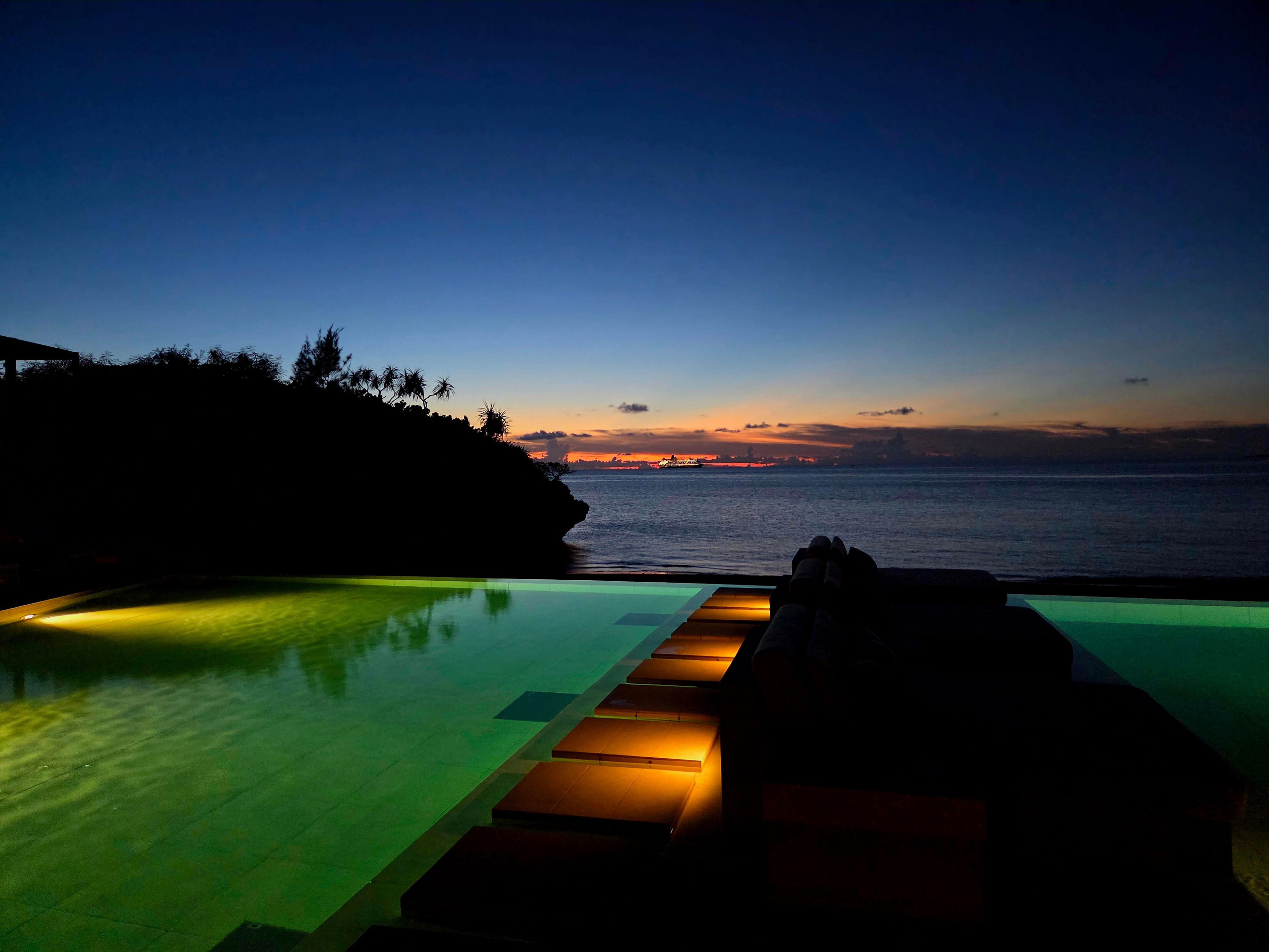
I changed into swimwear and jumped into the pool. The only sound was the gentle lapping of waves. The chaos of daily life seemed to wash away. At night, the pool transformed into a “starry sky theater.” Lying in the water, I gazed at Miyakojima’s sky, dense with stars. On clear nights, the Milky Way is visible to the naked eye here—a small island of about 50,000 people with no neon lights or even streetlamps. It was a vista forgotten under city lights.
Taste and Breath of Miyako Blue
The next morning, I did a Pilates session at the resort’s fitness center. Feeling refreshed after a good night’s sleep, I ordered a Japanese breakfast at the restaurant “Nagi” (Calm Sea). Though the restaurant has an Italian sensibility, it also serves Japanese cuisine for breakfast. Grilled fish with a hint of the sea, pickled island vegetables, Miyakojima-produced tofu, and fresh mozuku harvested from the nearby sea… The meal was as colorful and neat as a compressed version of the island’s land and sea. All three resort restaurants prioritize local ingredients.
I decided to explore the island. Miyakojima’s main island covers approximately 158 square kilometers. It takes 1–2 hours by car to travel from Higashihenna Cape, the eastern tip, to Ikema Bridge at the northern end. The Miyakojima City Comprehensive Museum in the center offers a glimpse into the island’s history, folklore, and nature. Exhibits include traditional costumes, ritual culture, native blue lizards, and coral, turtle, and fish specimens. Higashihenna Cape, where massive rocks were washed ashore by a 1771 tsunami, is also a must-see. There are also “utaki,” sacred Ryukyu religious sites historically accessible only to female priests. “Harimizu Utaki” is the only one open to the public. For snorkeling with tropical fish, “Nakanoshima Beach” is recommended.
Back at the resort, I swam in the “Miyako Blue” sea. The two beaches within the property are shallow and crescent-shaped, sheltered from waves. The island’s breath seemed to flow through the calm waters. Activities like kayaking, snorkeling, and paddleboarding are available with reservations.
The spa after swimming was heavenly. I entered the “Asaya Spa” building. After answering brief questions about my constitution, condition, and mood, I was guided to a private room. It felt like entering a small sanctuary. A bamboo basket held Okinawa’s traditional herb “getto,” Miyakojima salt, rice powder, and “kucha,” natural mud from the seabed. “This is a purification ritual where you wash your feet with a mix of these,” I was told. Soaking my feet in warm water, fatigue melted from my toes. Lying on a soft mattress, the herbal scent was clearer than the wind. Tension eased, and my mind settled. The masseuse’s hands released deep muscle tension, and I dozed off. When I opened my eyes, the 90-minute massage had flown by.
Dinner was at the resort’s seafood restaurant “Masu” (Salt), which overlooks the sea. “We named it to infuse the vitality of the sea and salt into our food,” the staff explained. Dishes included ceviche with thinly sliced white fish, red sauce, asparagus, and tomatoes; carpaccio with sliced scallops, okra, and cherry tomatoes; and “tataki” with seared tuna. All seafood was caught that morning and selected with local fishermen. The standout was soba noodles topped with golden uni, salmon roe resembling red jewels, and aromatic mozuku.
Back in my room, the sea’s taste lingered on my tongue. I looked up at the night sky again. Though the moon was brighter than the previous night, Miyakojima’s stars still shone. It was the perfect finale to the trip.

Post a Comment